Sep 02, 2026
In pad printing, manufacturers often pay close attention to steel quality, hardness, etching depth and ink formulation.
However, there is another small detail that can influence doctoring performance:
The grain direction of the cliché plate surface.
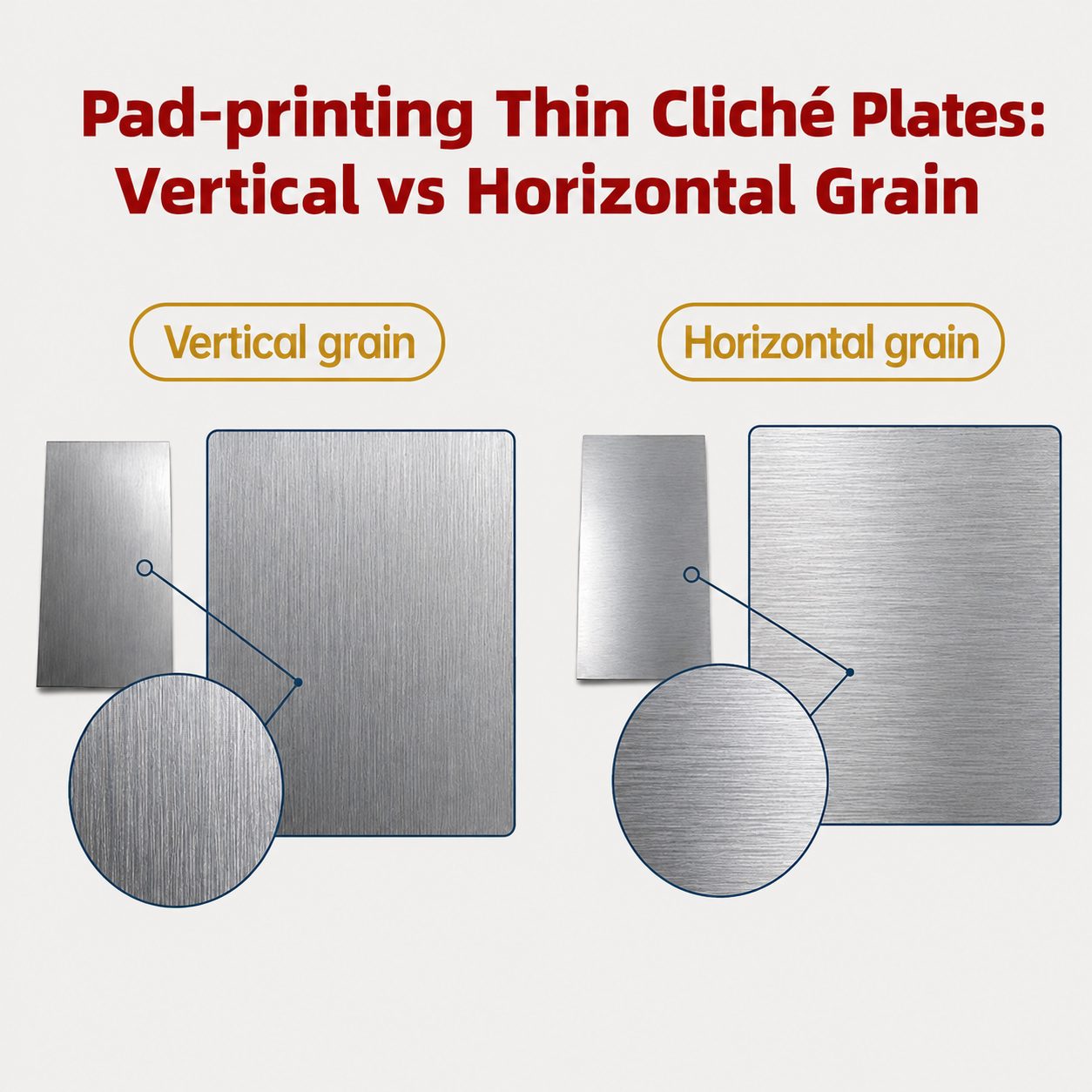
WINNEO thin cliché plates are manufactured from premium Swedish Sandvik steel. Depending on the application, we provide both standard Vertical Grain plates and customized Horizontal Grain plates.
So, what is the actual difference?
1. What Do “Vertical Grain” and “Horizontal Grain” Mean?
The terms do not simply refer to how the plate is visually positioned.
What really matters is the relationship between the surface grain direction and the doctor-blade or ink-cup travel direction.
Vertical Grain:
The surface grain runs approximately parallel to the doctoring direction.
Horizontal Grain:
The surface grain runs approximately perpendicular to the doctoring direction.
Although the difference may appear minor, it can influence ink residue during continuous doctoring.
2. Why Can Horizontal Grain Produce Cleaner Doctoring?
Even when a cliché plate appears perfectly smooth to the naked eye, its surface still contains very fine microscopic machining lines.
These lines can be considered extremely small grooves.
When the grain runs parallel to the doctoring direction, some ink can more easily follow these microscopic channels and remain on the plate surface.
Depending on the ink viscosity and operating conditions, this may contribute to:
•A thin ink film outside the etched image
•Slight darkening of the plate after doctoring
•Ink streaking
•Residual ink lines
•Increasing contamination during continuous production
With horizontal grain, however, the surface lines run across the doctoring direction.
This effectively interrupts the continuous microscopic channels along which ink could otherwise travel.
As a result, the doctor blade or ink-cup ring can remove ink from the non-image area more effectively in certain applications.
This is why horizontal-grain cliché plates can offer:
lower ink residue, cleaner doctoring and more consistent printing performance.
3. Why Is This Particularly Relevant for Closed Ink-Cup Systems?
In a closed ink-cup pad-printing system, surface grain influences more than just ink removal.
It can also affect the contact condition between the doctor ring and cliché plate.
The ceramic or carbide doctor ring needs to maintain stable and continuous contact with the plate.
If microscopic surface channels run continuously in the same direction as the ink cup travels, a very small amount of ink may more easily remain within those channels after the ring passes.
Horizontal grain interrupts these continuous paths.
For this reason, horizontal-grain plates can be particularly useful for applications involving:
Larger printing areas
Fine or demanding graphics
Products sensitive to background ink contamination
Low-viscosity inks
Continuous production
Closed ink-cup systems requiring particularly clean doctoring
4. Why Is Vertical Grain Still the Standard Choice?
This does not mean that vertical-grain plates are inferior.
In fact, vertical-grain cliché plates perform perfectly well for the vast majority of conventional pad-printing applications.
With the correct ink viscosity, a good doctor ring, proper machine adjustment and suitable plate quality, vertical-grain plates can provide highly stable and reliable printing results.
This is why WINNEO supplies vertical grain as the standard configuration.
Its advantages include:
•Broad application compatibility
•Mature and stable manufacturing
•Suitability for most standard pad-printing jobs
•Good cost-performance
•Easier stocking and delivery
Horizontal grain should therefore be viewed as an application-specific optimization, rather than a replacement for every standard plate.
5. More Visible Grain Does Not Mean Better Doctoring
There is another important point:
Horizontal grain does not mean that the surface should be rougher.
The ideal cliché plate requires:
Fine and uniform surface texture
Controlled surface roughness
Excellent flatness
Consistent grain direction
Proper compatibility with the doctor ring
If the surface texture is excessively rough, even a horizontal grain may contribute to:
•Ink trapped inside the surface texture
•Faster doctor-ring wear
•Ink residue
•Unstable doctoring
•Printing defects around the image
Therefore, cliché-plate performance should never be evaluated solely by asking whether it is horizontal or vertical grain.
Steel quality, surface roughness, flatness, etching quality, doctor-ring condition, ink viscosity and machine settings all work together.
6. Which Grain Direction Should You Choose?
A practical way to understand the difference is:
Vertical Grain — Standard Choice
Suitable for the vast majority of conventional pad-printing applications and provides reliable performance under normal operating conditions.
Horizontal Grain — Optimized Choice
Worth considering when cleaner doctoring is required, or when a customer is experiencing noticeable ink residue or streaking on the plate.
However, changing the grain direction alone cannot solve problems caused by poor plate flatness, a worn doctor ring, excessively thin ink or incorrect machine settings.
The better approach is to select the cliché plate according to:
machine configuration, ink-cup size, image area, ink characteristics and actual doctoring conditions.
WINNEO Recommendation
Surface grain may appear to be a small detail, but in pad printing, small details often determine long-term production stability.
If you are experiencing:
incomplete doctoring, ink residue, streaking, dirty backgrounds or reduced cleanliness during continuous production,
in addition to checking the doctor ring, ink viscosity and machine settings, it may also be worth checking:
whether the cliché plate grain direction matches your doctoring application.
For most standard jobs, vertical grain is sufficient.
For applications requiring cleaner doctoring performance, horizontal grain can provide an additional optimization option.
The right cliché plate should not only make printing possible — it should help the entire pad-printing system operate more consistently.
อ่านเพิ่มเติม






 IPv6 รองรับเครือข่าย
แผนผังเว็บไซต์
| XML | บล็อก | นโยบายความเป็นส่วนตัว
IPv6 รองรับเครือข่าย
แผนผังเว็บไซต์
| XML | บล็อก | นโยบายความเป็นส่วนตัว
 ไทย
ไทย English
 Русский
 Italiano
 Español
 عربي
عربي 한국어
한국어 Türk
Türk Polski
 ไทย
ไทย Tiếng Việt